May 7, 2018
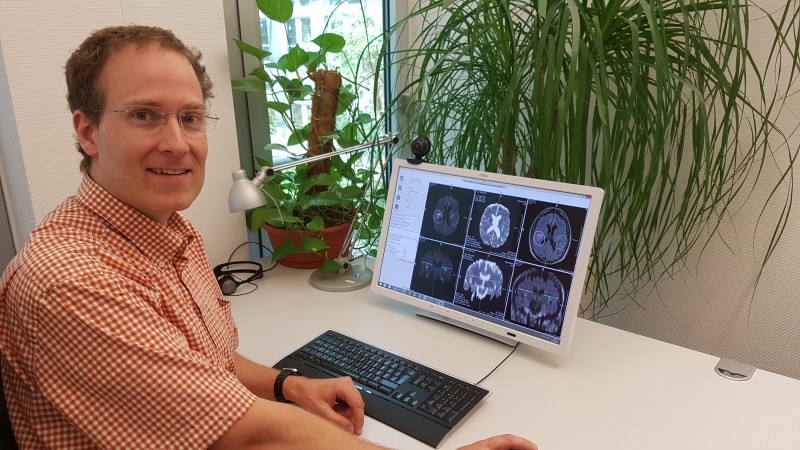
Jan Klein; Photo by Fraunhofer MEVIS
Stroke is a devastating disease leading to death and disability in large numbers of patients with massive social and economic impact. Intravenous thrombolysis with Alteplase is available as an effective and safe treatment of acute stroke if given within 4.5 hours of symptom onset.
However, in about 20% of acute stroke patients the time of symptom onset is unknown e.g. because symptoms are recognized when waking-up from sleep in the morning. This large group of patients is currently excluded from treatment with Alteplase only due to the missing information on the time of symptom onset.
WAKE-UP was a European multicentre investigator-initiated randomized placebo-controlled clinical trial of MRI based thrombolysis in acute stroke patients with unknown time of symptom onset.
In preparatory work, the WAKE-UP consortium developed an innovative approach of using brain MRI as surrogate marker of stroke lesion age which may be used to identify stroke patients likely to benefit from thrombolysis.
The final results of this trial will be presented at the press conference within ESOC 2018, in Gothenburg, Sweden, from 11:40 to 11:50 CET on Wednesday, 16 May.
As the revealing of the WAKE UP trial results approaches, SAFE used the opportunity to talk with the two scientists, Jan Klein from the Fraunhofer Institute for Medical Image Computing MEVIS, Bremen, Germany and Bastian Cheng, from School of Medicine and University Hospital Hamburg-Eppendorf to learn more about SONIA – the diagnostic imaging software that was developed during the course of the project. (more…)
May 3, 2018
First published on ScienceDaily.com
A study led by Massachusetts General Hospital (MGH) investigators may lead to a significant expansion in the number of stroke patients who can safely be treated with intravenous tPA (tissue plasminogen activator), the “clot busting” drug that has greatly reduced stroke-related disability and deaths in eligible patients. The report, published online in Annals of Neurology, describes the results of a trial using MR-based imaging technologies to identify patients likely to be within 4.5 hours of stroke onset, even though their initial symptoms had not been witnessed. (more…)
May 3, 2018
First published on ScienceDaily.com
The diagnosis is one that a family never wants to hear: Your father has Alzheimer’s disease. Your mother has stroke-related dementia.
A recently released study, included in a special supplement to the Journal of Gerontology, indicates that dementia’s impact might be compressing a bit. That is, people might be developing dementia later and living with it for a shorter period of time. (more…)
May 3, 2018
First published on ScienceDaily.com
An experimental compound appears to improve stroke outcome by reducing the destructive inflammation that can continue months after a stroke, scientists report.
Rats consuming compound 21 following a clot-based stroke — the most common type in humans — don’t have a smaller stroke size but do have better memory and movement in its aftermath, says Dr. Adviye Ergul, vascular physiologist and Regents’ Professor in the Department of Physiology at the Medical College of Georgia at Augusta University. (more…)
May 3, 2018
First published on ScienceDaily.com
A new computer programme developed by scientists at the Universities of Edinburgh and Glasgow can assess whole brain deterioration and help predict cognitive function after stroke up to ten times more accurately than current methods.
The new approach, published today in the International Journal of Stroke, can quantify visible brain injury from cerebral small vessel disease (SVD) and brain atrophy by translating the million plus bits of information stored in brain scans into a single measure, the “brain health index.” (more…)